
Teller County Court Records After a Jail Arrest
Teller County criminal cases are handled in Colorado's Fourth Judicial District. After an arrest and booking at the Teller County Detention Center, the jail roster may show a booking-level offense, a hold, the arresting agency, and bond information. That roster entry is not the same thing as the formal court case. Court records after an arrest begin to matter when the prosecutor files a complaint, information, indictment, or other charging document that opens or advances the case.
The local court contact is the Teller County Courthouse, 101 W. Bennett Avenue, PO Box 997, Cripple Creek, CO 80813. The courthouse is open Monday through Friday, 8 a.m. to 4 p.m., except state holidays. General Teller case questions go to tellerclerkgeneral@judicial.state.co.us or 719-689-7360. Booking and custody details remain separate from court filings, so use jail inmate records for roster status and jail mugshots for booking-photo details.
The Colorado Judicial Branch's Teller County court page identifies the courthouse, hours, and case contact information.
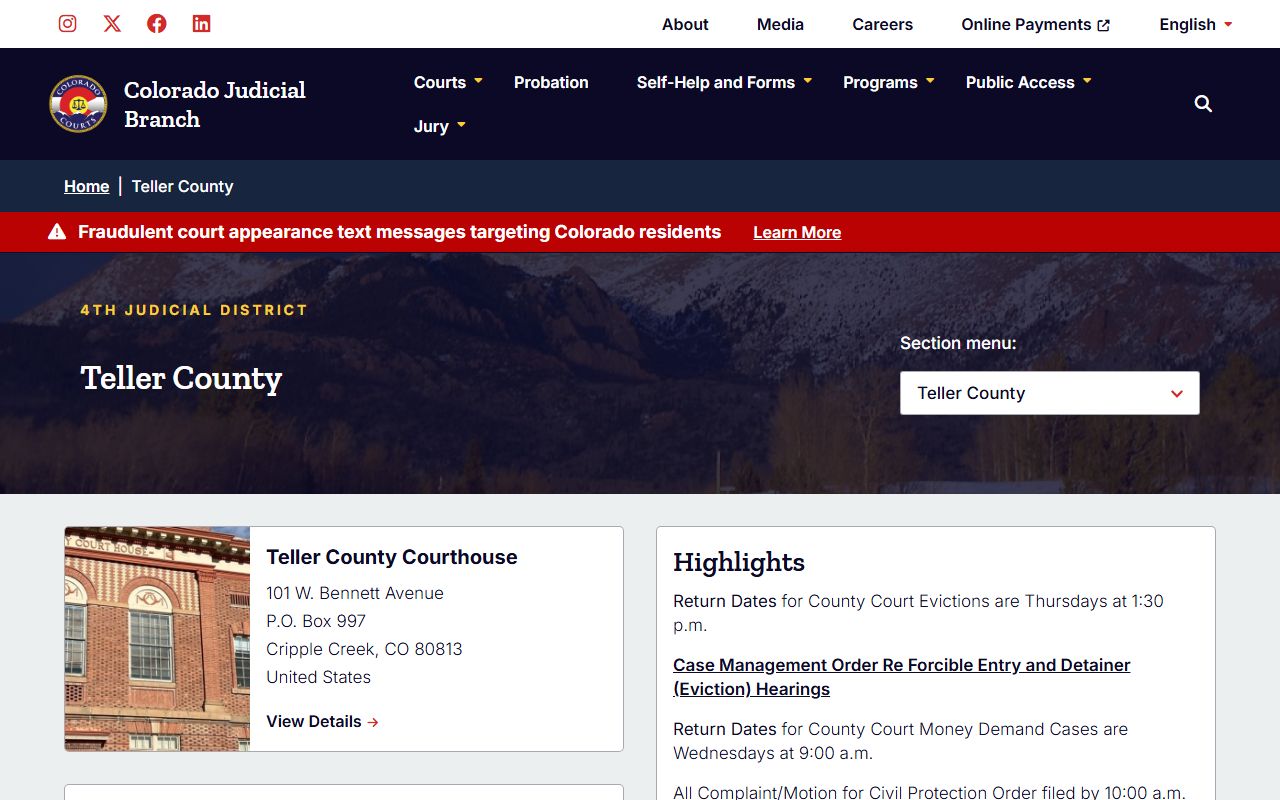
That court page is the better source for courthouse routing, while the detention roster remains the better source for immediate custody and booking status.
How to Find Teller County Court Records After an Arrest
Start with the booking record if the question is whether someone is in custody. Move to the Colorado Judicial docket search when the question is what case, charge, date, division, or party information exists in court. The docket search is useful for court dates and case identifiers, but it is not a complete document repository. Colorado's access guide says copies must be requested from the court, through the online records request form, or through the applicable court location rather than from vendor sites.
- Open the Colorado Judicial docket search and choose Teller County or the Fourth Judicial District when that filter fits the search.
- Use a defendant name, case number component, attorney field, court type, courthouse, or other filter along with the date requirement.
- Open the docket result and compare the charge list with the booking-level offense shown by the jail roster.
- Check each listed charge for its code, court type, division, hearing date, status, and disposition when available.
- Request actual documents through the court record request process if the docket does not show the needed filing.
The Colorado Judicial access guide also explains that limited online register access may be available through third-party vendors such as CoCourts or LexisNexis, that charges may apply, and that those vendors do not provide court document copies. Treat vendor registers as a search aid, not as the official document-copy path.
The official Colorado docket search is built around location, date, case, party, and attorney filters.
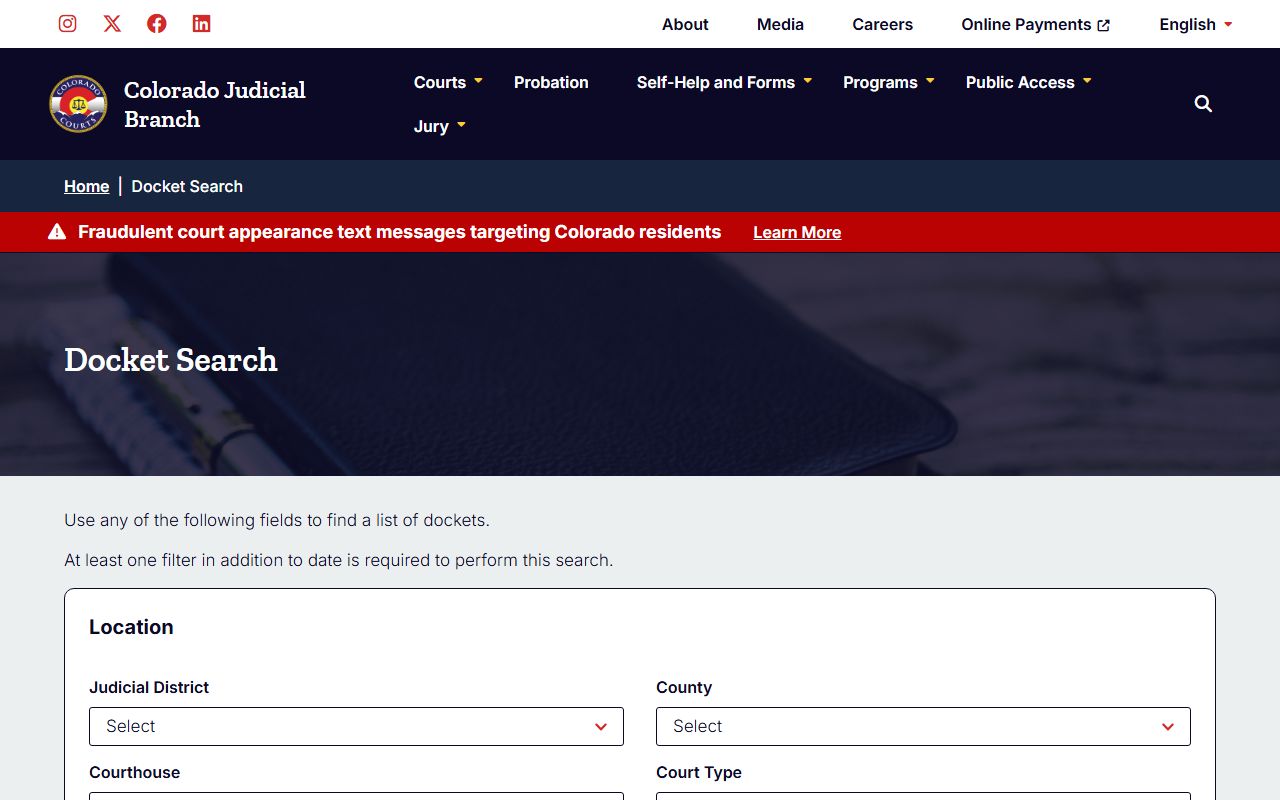
For Teller County, the most practical filter combination is usually county or courthouse plus a party name, case number, court type, or attorney field.
The Colorado Judicial Branch public records access guide explains why docket lookups and document copies are handled through different paths.
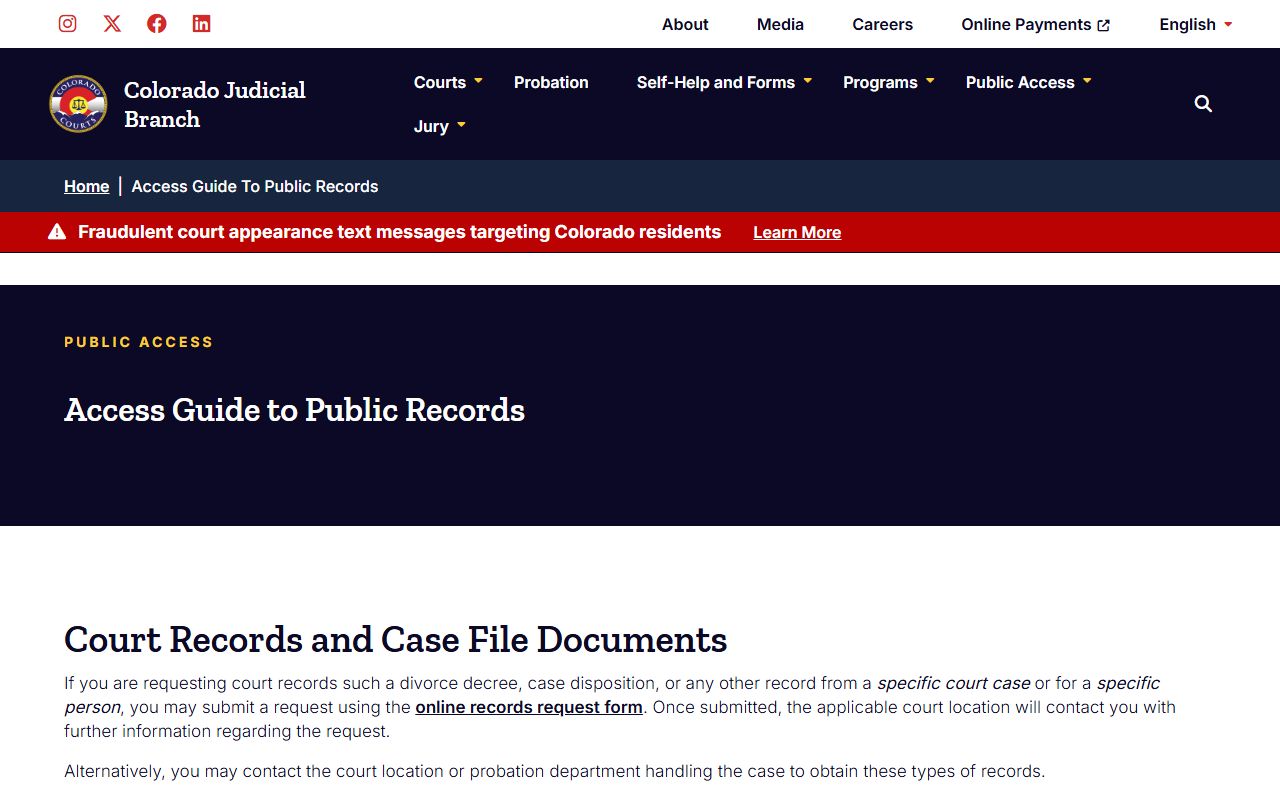
That distinction helps prevent a common error: finding a case register online and assuming the underlying complaint, order, or disposition document is available from the same screen.
Colorado Docket Search Fields for Teller Court Records
The docket form requires at least one filter in addition to date. That rule matters because a date-only search will not run. Teller County users can narrow the search by court location, case number parts, party details, business name, attorney name, or attorney bar number.
| Field | How It Helps |
|---|---|
| Judicial District | Select the Fourth Judicial District for Teller County criminal matters when searching by district. |
| County or Courthouse | Use Teller County or Teller County Courthouse to avoid pulling statewide results. |
| Court Type | Choose Both, County, or District. Misdemeanor, traffic, and felony matters may route differently. |
| Date Range or Specific Date | Use the available date range choices, but add another filter because date alone is insufficient. |
| Case Number | Enter year, case class such as CR or M, and sequence when known. |
| Party Name or Business Name | Search by individual defendant name or business party name when no case number is known. |
| Attorney Name or Bar Number | Use attorney fields when the lawyer is known but the case number is not. |
How Charges Get Filed After an Arrest: Complaint, Information, and Indictment
The arrest-to-court path can change the wording and severity of charges. A jail profile may show the primary offense entered during booking, but the Fourth Judicial District Attorney reviews reports, holds, evidence, and applicable law before formal charges move through court. District Attorney Michael J. Allen serves Teller and El Paso Counties. The Teller County DA office is at 112 N. A St., PO Box 958, Cripple Creek, CO 80813, with a local phone number of 719-520-7168. The main office is 105 E. Vermijo Ave., Colorado Springs, CO 80903, 719-520-6000. The DA's public profile is posted by the Fourth Judicial District Attorney's Office.
| Complaint | Information | Indictment | |
|---|---|---|---|
| Filed By | Often initiated by law enforcement or a prosecutor | Prosecutor | Grand jury |
| Common For | Early criminal filings and many misdemeanor or complaint-stage matters | Many felony prosecutions after prosecutor review | Serious or grand-jury-reviewed felony allegations |
| Effect | Begins or supports the criminal case | States the prosecutor's formal charge decision | Accuses the defendant through grand jury action |
Charge Status in Court Records After Arrest
Charges can be pending, amended, reduced, dismissed, resolved by disposition, or become convictions. A person may be booked on one label and later face a different filed charge after prosecutor review. That is why a booking roster should not be treated as the final charge history. Read every court charge separately, especially when there are multiple counts or when one count is dismissed while another is resolved by plea or verdict.
| Status | What It Means |
|---|---|
| Pending | The charge is unresolved and remains before the court. |
| Amended or Reduced | The prosecutor or court changed the charge label, severity, count, or offense level. |
| Dismissed | The charge was dropped or terminated and did not become a conviction on that count. |
| Disposition | The final result for a charge or case, such as plea, verdict, dismissal, or sentence entry. |
| Conviction | A finding or admission of guilt. It is not the same as arrest, booking, or accusation. |
Bond and Release After an Arrest
Teller's detention page links to Online Bond Posting and says the Sheriff's Office has entered into an agreement with Genesis eBONDS for surety bonding under House Bill 25-1015. The county says more information will be available when integration is complete, so do not assume every surety process is already available online. Confirm the current bond status before payment, especially if the roster shows a federal hold, ICE hold, no-bond status, or another-agency detainer.
| Bond Type | How It Works |
|---|---|
| Cash Bond | Money is paid through the authorized court or jail process when a cash bond is ordered. |
| Surety Bond | A licensed surety process may be used when allowed. Teller references Genesis eBONDS but notes integration information may still be pending. |
| PR or Own Recognizance | Release is based on a promise to appear and conditions rather than full cash payment. |
| No-Bond or Hold | The person may not be releasable by ordinary payment because of a warrant, detainer, federal custody, ICE status, or court order. |
Warrants That Lead to an Arrest
No official active Teller County warrant search was located in the inspected research. The Teller court page does warn that a failure to appear in person on a traffic or misdemeanor ticket may result in a bench warrant for arrest. For practical checking, use the docket search for court dates and case context, contact the court for case questions, and avoid treating private listings as warrant-clearing tools. A warrant question can affect bond, release, and whether the jail roster shows a hold instead of a standard local charge.
Charges vs. Convictions
An arrest and a charge are accusations, not final findings. A conviction requires a plea, verdict, or other court result that establishes guilt. This distinction is central when reading Teller County court records after arrest because early booking labels often appear before the formal case is narrowed, amended, or resolved.
| Charge | Conviction | |
|---|---|---|
| Stage | Accusation filed or pending in the case | Final guilt result by plea, verdict, or qualifying disposition |
| Proof Level | Based on probable cause and charging review | Requires proof beyond a reasonable doubt or an admitted plea |
| Record Meaning | Shows what was alleged or prosecuted | Shows what was legally established as guilt |
Sealed vs. Expunged Arrest Records
Colorado record-clearing questions depend on the case type, outcome, age of the record, and court order. Teller County did not publish a separate arrest-record removal shortcut in the inspected source material. For a criminal case, the court process controls the case record, and the original records custodian handles local record consequences after any qualifying order.
| Sealed | Expunged | |
|---|---|---|
| Public Visibility | Hidden or restricted from ordinary public access after a qualifying order | Removed or treated as unavailable under a more limited legal process |
| Agency Access | Some criminal justice access may remain depending on Colorado law and order terms | Access is more restricted and depends on the record type and statute |
| Practical Step | Use the court process, then contact the custodian about affected local records | Use the specific Colorado process that applies to eligible records, especially juvenile or statutory categories |
Background Check Considerations
Casual court lookups and criminal-history screening are different tasks. Colorado court records and jail roster entries can be incomplete, recently changed, or limited by sealing, juvenile-record rules, redaction, and access policies. Employers, landlords, insurers, lenders, and similar decision makers must use legally compliant consumer reporting channels rather than informal web searches.
Important: Teller County Inmate Population is not a consumer reporting agency and cannot be used for FCRA-regulated decisions.
Restricted Court Records After an Arrest in Teller County
Not every record tied to an arrest is public in full. Colorado's public-record and criminal-justice-record frameworks allow redaction or withholding when required by law. Juvenile and child-related records are limited under C.R.S. 19-1-301 through 304. Colorado's HB24-1090 privacy protections also affect certain identifying information in criminal justice records, especially for certain victims and child victims or witnesses. When a docket is visible but the filing is not, request the document through the court and expect possible redaction, denial, or narrower release.